Wednesday, 3 February 2016

Workshop 5: Tu B'shevat By Gita Margolese

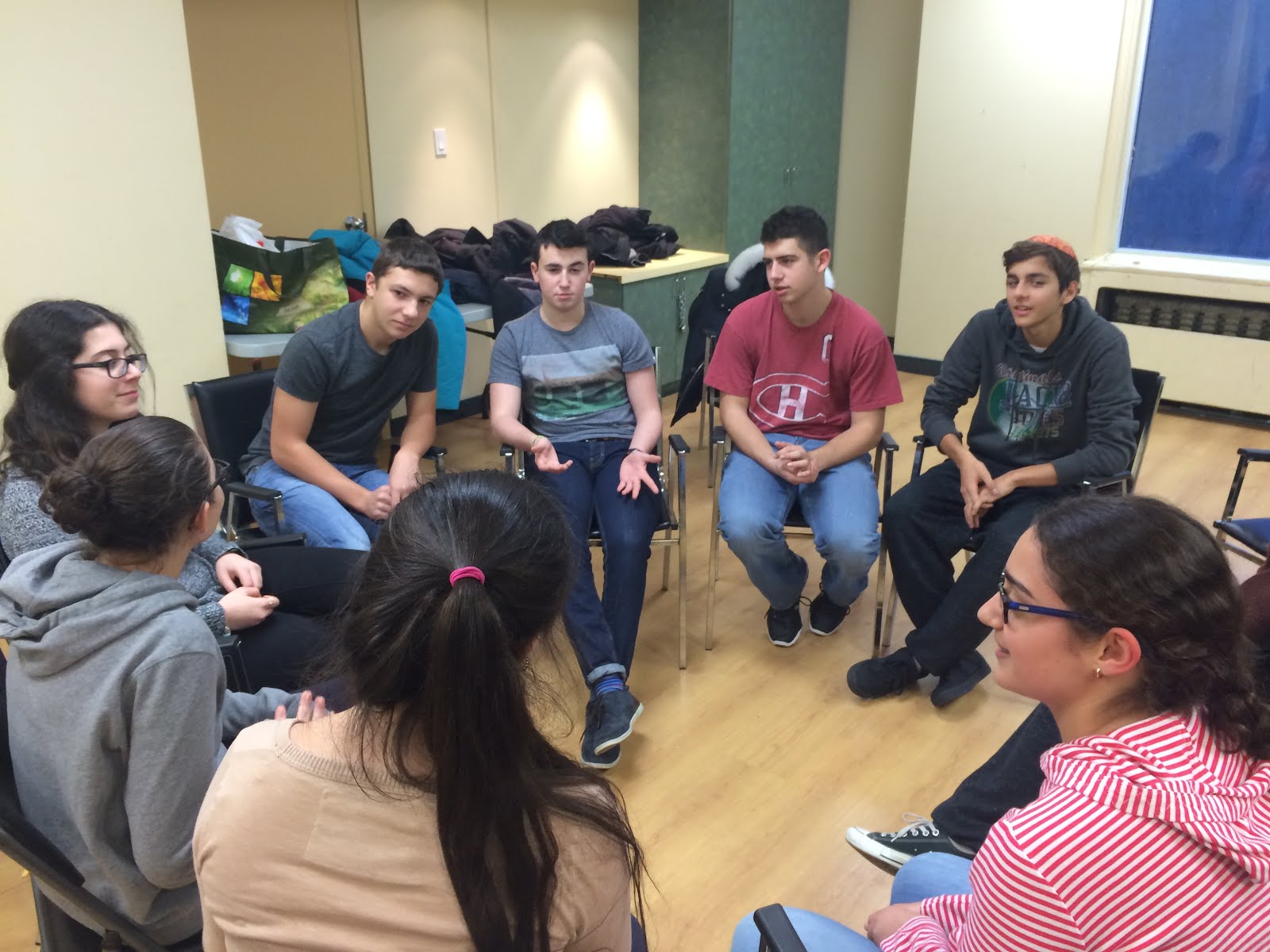
This past Sunday we had another fun and educational wokshop. The theme of this workshop was Tu B’shevat. We discussed what trees symbolize and the importance of appreciating nature.

The workshop began with each fellow describing their roses, thorns and buds of the week. Roses represent something good that happened during the week, thorns represent something bad that happened and buds represent something we are looking forward to in the near future. Many of us said that our bud was the upcoming Shabbaton which I know I can’t wait for!


Next, we had a Tu B’shevat Seder led by our amazing JCs, Rebecca Gotteiner and Spencer Albert. In the Tu B’shevat seder we drank four glasses of grape juice, each glass darker than the previous one, starting with white grape juice and ending with red grape juice. We also ate three different fruits, the first one with a hard outer shell (oranges or grapefruit), the next one with a hard middle or pit (olives or dates) and finally, the last one being completely edible throughout (raisins and blueberries). Each of these represent different level of purity, holiness and potential. During the seder, we also had a five minute meditation session where we were able to relax and unwind and simply focus on our breathing which really helped refresh us after a tiring and long week.


After the Seder, we acted out a story as a group about Honi ha-M'agel who was once walking and saw an old man planting a carob tree, a tree that takes 70 years to grow. He asked the man why he was planting the tree and the man told him that he was planting the tree, not for himself but for future generations. The old man then fell asleep and when he woke up, 70 years had passed and he was able to benefit from the carob tree that he had planted many years earlier. We reflected on being grateful for what nature provides for us, as well as the importance of ensuring that future generations get to benefit as well.


We then were each given a picture of a tree to personalize. The tree represented who we are as a person where the roots represented where each person comes from, the trunk represented our core, our beliefs and our morals and the branches and leaves represented our aspirations and goals for the future.

After our creative work we had a short break for lunch where we made delicious falafel.
After lunch, we had an amazing program run by Avital Beller, our shinshinit. The group was split into two teams. Each team wrote down words related to Tu B’shevat on individul pieces of paper and put them on a plate. Each team then acted out charades with the words written by the other team. The next part of Avital’s program involved spliting into four groups. Each group was given an article relating to either Tu B’shevat or trees and we discusses our articles in our groups.
We then broke off into our committees for the Shabbaton and finalized our programs.

Finally, Sarah, our awesome coordinator explained what the Jewish Community Mifgash with the Israelis would be like. We brainstormed as a group some fun activities that we could do when our fellows from Be’er Sheva arrive. We all had an amazing time at the workshop and can’t wait to see each other again soon at our Shabbaton! I would lastly like to thank Sarah, Rebecca, Spencer and the whole Diller team for all the time and devotion that they put into making each aspect of Diller run smoothly. We really appreciate you!

By Gita Margolese

Monday, 11 January 2016

Workshop 4: Montreal Jewish Community and Self-Management by Naomi Spiegelman


At every Diller workshop, the teen fellows get to explore different topics that are part of the fundamental principles and objectives of Diller. This workshop was about the Jewish community and working on our self-management (leadership).


During the first part of today’s workshop, Leah Berger, a Senior Planning Associate from Federation CJA came to speak to us and explained a bit more in depth about our Jewish community, and the many agencies affiliated it. We learned how the funds raised by the annual campaign are allocated to the various agencies. Afterwards, we had fifteen minutes to do a mock money allocation with 5 agencies and $3.9 Million. Although there was a time strain, it was very interesting to see how everyone has different thoughts and views on what are the priorities, what is urgent and what is not. There was some discussion about whether it is a Jewish priority to provide services for non-Jews as well, and Leah told us that this is a point of discussion in the allocations meetings as well. Within this, we briefly spoke about a topic that is very important to me: Tikun Olam. Tikun Olam in English means to repair the world, to make it a better place by performing acts of kindness.


Afterwards, we had a lunch break. Following lunch, we worked on the self-management topic. Sarah presented to us the Journey of Bread and Water (also known as Milk and Cookies). We learnt about the importance of creating a mission, a vision, goals and objectives. This session was also an introduction to our next project. We have a Shabbaton coming up relatively soon and different committees in our Diller Group are responsible for planning different sections of the Shabbaton. My committee is in charge of “Rituals”. We brainstormed in the allotted time and will continue planning and working on our self-management as the shabbaton approaches.


By Naomi Spiegelman

Monday, 14 December 2015

Workshop 3 by Amanda Marciano


This past Sunday, our cohort had another great workshop. The theme of this workshop was Current Events and Media Bias.  We talked about current events happening around the world and how they affect us. We also learned a lot about media through discussions and games.

When we first arrived, we were shown media posts and headlines about Israeli bias in social media. We then went back to have a great discussion on what the media had to say about Israel and how biases exist on both sides. We also discussed the kind of information that the media gives us and how media works and how sometimes it can give false information. We discussed together as a group the pros and cons of this and how it affects all of us.

We then moved on to playing a fun game organized by our JCs.  We were split up into two groups and were given statements made by Jews, Christians, Muslims or other people and we had to guess by who this statement was given by. It opened our minds and gave us a chance to reflect on the points of view of other religions.


 After a nice break to talk, relax and eat some snacks, we moved on to our next activity. We were again split up into four groups and each group was given a different article to read and discuss. Each article stated something different on similar topics. For example, one article talked about discrimination toward Palestine. It talked about how there are people who are against Palestine and some are for them. Everyone has their own opinion about this. The article also talked about how there are people who discriminate against Palestine and think that all Palestinians are terrorists and bad people. After everyone came back together, each group got the chance to talk about their article and share with the rest of us what was discussed within their group.


Afterwards, we were very excited to learn that we will soon get the chance to speak to our Israeli pen pals. Since Sunday was the first night of Chanukah, we all lit the menorah together and recited the blessing for Chanukah. It was very nice to be able to light the menorah together. Lastly, we made a short video to send to our Israelis wishing them a happy Chanukah!


I think that we all left the workshop with something a new point of view on things. I look forward to meeting our Israeli pen pals. Overall, it was another great and successful workshop. I am very excited for the next meeting. I can’t wait to see what we will learn next! 

by Amanda Marciano

Wednesday, 2 December 2015

Cohort 8's First Shabbaton Part 2 - by Meir Hersson-Edery

Last week's Diller shabbaton was a perfect opportunity to bond with the other amazing people from my Cohort. I learned so much and created or strengthened my relationship with everyone who came on the shabbaton. We also discovered new things about ourselves, mostly about our Jewish identity, who we consider Jewish and the different types of Jews. We learned tolerance towards these different sects of Judaism and to respect their opinion without judging them. We had many activities which allowed us to reflect on our inner values and what we believe.

On Saturday afternoon we started with a spectrum activity. Sarah created a game where a spectrum was created, one side labeled "Agree" with the other end of the room labeled "Disagree". She would then give us a statement ranging from " I believe in God" to " Jews can be better Jews than others if they follow the laws of Judaism". Since these questions are nearly impossible to completely agree with, this was the beauty of the spectrum. I could see how everyone felt about a certain issue. I could also understand how strongly someone felt about an issue. Sarah would then choose several people at either end of the spectrum and would ask them to explain their position. While I didn't agree with everything said, I could sympathize with my friends' positions. I also drew from this exercise the conclusion that while people's opinions are not entirely dependent on their background and history, it plays a huge part in their ideology. Another (perhaps unexpected or expected, I'm still not sure) consequence of the game was that people on either end of the spectrum would respectfully argue their points among one another, trying to understand why the other person had their thoughts. I believe most of the cohort changed at least one of their opinions on the topics brought to the table. This was the usefulness of allowing everyone the opportunity to speak and make their case in front of everyone.

Between every break, we had some time to ourselves where we were encouraged to talk to people who we didn't know very well. I made good use of this time and talked to everyone on the shabbaton. I now feel comfortable around everyone I talked to and consider them all my friends. I hope the sentiment was shared by all. We would just sit in the hallways, talking about anything, having a good time bingeing on snacks and enjoying the company of everyone present. We also had lots of fun exploring the hotel and running around laughing.


After the spectrum activity and a break,  we did Havdala, the blessing of escorting the angel of Shabbat out and mourning the loss of the holiness of this day. We celebrated these blessings in song and camaraderie. It was an incredible experience.


From there, we went to dinner, and then Avital, one of the Diller Shinshinim, created a game that we played in earnest. We were split into four groups. Each group was then given a stream of Judaism about which they were supposed to make a skit with the intention of the other groups to be able to guess which stream of Judaism your skit is representing. I was made to act out "Reform Judaism", which by my own admission, was probably the worst skit out of all the groups. We had lots of fun listening to all the different skits and our friends making jokes and generally embarrassing themselves. We learned a lot about different types of Jews and what they believe are the core values of Judaism while having lots and lots of fun. This program was incredible and I wish I could do it again and again.

We had little time to spare though, since we had to rush to our next event. We were going to play laser tag. We were all ready to go so we walked over to the metro station and made our way to the laser tag arena. Nothing very interesting happened on the trip over. To be honest I was secretly not wanting to play laser tag, but once I arrived I quickly got into the mentality. It was incredible to let off some steam and have some fun with my good friends. We had an incredible time and were all happy and tired as we returned to the hotel.


There were two final activities to partake in still that night though. The first was fairly simple. It was just updates as to what was happening with the situation in Israel. The second activity was Ma'agal Laila. We sat in a circle and reflected over the day's activities.

On Sunday morning, we had the opportunity to give feedback, criticisms and compliments to the staff about the schedule, programs, logistics or any other issues we had with the shabbaton. We also named our mascot, a penguin, giving her the name of Justin Pamplemousse Vegeta Trudeau Diller. I'm still not sure how that name came to be.

To conclude, this shabbaton was nothing short of amazing. I learned so much about my fellow Cohort members. We connected and I learned so much about myself and others. After the shabbaton, I wasn't able to do anything since I was so tired from having such a good time. I suppose you can have too much of a good thing!

Cohort 8's First Shabbaton Part 1 - by Noah Zlotnik


From November 20-22, we had our first Diller shabbaton! The theme of our shabbaton was Jewish identity. This meant that during the shabbaton, we were going to do activities in order to learn more about our Jewish selves and perspectives. During this process, our cohort became extremely unified as we discovered our inner selves as well as others'. Through various thought-provoking discussions, we had to come out of our shells and answer personal questions. But ultimately, this led us to not only understand our fellow Fellows better but to understand ourselves better as well. They started off as just my cohort but I can now gladly call them my second family.

Anywho, first things first we all arrived at the Quality Hotel, got our card keys (or regular keys for those who are shomer), and dropped off our bags in our rooms. We were then explained all the rules for the shabbaton, and were told to go get ready for Shabbat. When we all came back down in our nice clothes, we were surprised with a visit from Rabbi Pinny Gniwisch. He tried to learn all our names, but had a hard time doing so. The girls then lit the candles welcoming Shabbat. After explaining to us the meaning behind lighting the candles, Pinny introduced a task to us. He divided us into 4 groups. He gave each group a pack of around 20 cards, each card exhibiting a different either Jewish belief, custom or law. We were tasked with deciding upon a top 5 cards, then top 3 in terms of most important Jewish values. The card that every group had in common was the one that explained how Jews as a people must pass down Jewish traditions from one generation to the next. We all thought this was very important because no matter how observant you are, what sect of Judaism you come from, every Jewish person must learn the traditions and customs of their own family, and pass it down to their kids.

After assessing our Jewish priorities, we held services (Kabbalah Shabbat) led by our very own fellow, Ian Langleben. There was plenty of singing and dancing. After that we had a delicious Shabbat dinner. After we said the Birkat Hamazon, Pinny led us in more singing.
Our JC's then organized a team-building activity for us. We were split into two and we had to complete various tasks either faster or better than the other team. These tasks included karaoke, ninja, Jewish trivia... There was one game where we had to pair up and one person from each duo would have to put a shoe in the middle of the circle. Their teammate would then, blindfolded, have to go pick out your shoe out of a pile of shoes. My team won almost every competition. We then played stump the rabbi, which was not necessarily to literally stump the rabbi, but rather to ask questions about Judaism that we've always wanted the answers to. This activity forced us to search through our Jewish identities and find holes that needed to be filled. Personally, that experience really enhanced by own Jewish identity, and made me think more about my connection to the divine, whether there is something greater than all of us.

After a well deserved snack break, we went into our first Ma'agal Lailah as a cohort. Ma'agal Lailah translates to 'Night Circle.' We sat on the floor in, you guessed it, a circle. We were asked some serious questions like, "Who in your life has had the greatest impact on you?" And some less serious questions like "What song best describes you when you wake up in the morning?" This was an opportunity for us to open up to our Fellows, and really share our feelings. Through this we all became really close, really fast. With everyone sharing life experiences, opinions, we got to know each other almost instantaneously. After an extremely meaningful conversation we went upstairs two the hallway outside our bedrooms, and just us Fellows got to chill and talk to each other. Sadly, curfew came around pretty quickly and we all went to our rooms. I stayed up for a bit longer talking to my roommates Jared and Yoel, and I got to know them a bit better.

The next morning we woke up pretty early for a Saturday morning, ate breakfast all together and then walked the Dorshei Emet, the Reconstructionist temple. We talked to Rabbi Aigen about what reconstructionist Judaism really is. We learned that most decisions are based on what the community wants rather than decisions made by the rabbis and the sages. Their services were quite different from what I was used to. They changed certain words in certain paragraphs in order for them to support their ideology better. Growing up going to a modern orthodox synagogue, there was more listening than singing. However, in this synagogue everyone sings together, and it sounded really nice. Although I did not agree with a few things that they did, I was able to truly respect their ideas and mentality. I learned a lot more other kinds of Judaism than I had ever learned before.

Although this shabbaton was supposed to teach us about different kinds of Judaism and provoke more thought into our own Jewish identities, I found myself learning a lot about my cohort. Before Diller, I barely knew most of the other Fellows. After our first workshops, I got to know them a little better. However, this shabbaton was when I really learned a lot about them. Strangers became friends became a family. We became a unit. I cannot wait for the next workshop!!!